
A 90 Minute Documentary - East 2 Eden - Cain and Abel
(click on picture above to see 54 MB Windows Media Player demo Note: Mac users may need to first download free Windows Media Player for Mac OS X 9.0)
Why
do brothers kill brothers?

Religious conflict between brothers is not only a very ancient problem but also a challenging modern one: an ongoing phenomenon that is difficult to fully understand yet imperative to the future of humanity...

While
violence is a part of every culture in the world, places where there has
been extreme violence can teach us a great deal about how to deal most
positively with the forces in human nature that fuel violence and even to
help us better understand these forces in ourselves.
It has been said that all good documentaries have a problem that is being investigated as their central premise: East 2 Eden - Cain and Abel investigates the conflict between the biblical brothers Cain and Abel from a modern perspective.... the fact that as much as we would like to be followers of Abel, according to the bible, we are all descendants of Cain. The bible tells us that Cain killed his brother because he was jealous of his brother Abel's acceptance by God. What does this mean for us today? What is it about faith that seems to pit people of different faiths against one another? If religion is about peace and love, why is it also a cause for so much war and conflict? This tradition of Cain and Abel is shared by Islam, Judaism and Christianity ... is there a possibility of building towards common understanding from this?
Since the events of September 11, 2001, world religions and Islam in particular have become the object of great public interest. Events since that time have not diminished the importance of promoting interfaith dialogue and developing deeper understandings. Although modern Turkey is a very popular tourist destination for many people, remarkably few people are aware of much of the country's immense historic religious significance. For many who are not part of a practicing religious tradition or indeed part of any faith tradition, there can be honest curiosity about where various faith traditions have come from and why each believes as it does. But what about the hatred and mistrust between believers? Where does this come from and is there some way to overcome such negative ideas and emotions? Through interfaith dialogue East 2 Eden - Cain and Abel provides an exciting new opportunity to explore the rich insights about faith against a backdrop that only Turkey can provide.
Turkey is a modern cosmopolitan country with a profound spiritual and religious history relating to Judaism, Christianity and Islam. Its cultural diversity and policy of multiculturalism plus the rich interchanges between faiths over the past six millennia make it well suited to an investigation of faith that attempts to explain where major world faith traditions - especially Judaism, Christianity and Islam - have come from. If bridges of co-existence and understanding can be built and maintained possibly this is a place to start. Turkey has important traditions and experience that are not so well know that may contribute to such an understanding on many important levels. For example there are little known textual sources that may provide new insights:
... And Cain hastened and rose up, and took the iron part of his ploughing instrument, with which he suddenly smote his brother and he slew him, and Cain spilt the blood of his brother Abel upon the earth, and the blood of Abel streamed upon the earth before the flock. Sefer Hayyashar 1:22
Was there something about the introduction of metallurgy and agriculture that underlies the story of Cain and Abel? Could this relate to cultural change and new technologies today? In their day, possibly Abel represented traditional nomadic life and its religion while his brother was an early adopter of new technology and the changing belief systems that went with it. We are told that Cain was the eldest and that he had scorn for for his brother Abel's traditional religious faith. While we all might like to have the traditional faith of Abel, many people these days are challenged by changes in culture, religion and technology. Surely we can all relate to Cain's grief over killing his brother and God's forgiveness of Cain... The reference to iron is interesting as our earliest knowledge of iron use dates back to the fifth millennium BCE (see James D. Muhly, "Mining and Metalwork in Ancient West Asia", IN Civilizations of the Ancient Near East vol. III, Jack Sasson ed. in chief, 1995, p.1514).
The Hebrew word used for iron is believed to be a loan word from the ancient Sumerian BAR.ZIL via Akkadian parzillum or possibly from Hittite. The use of terrestrial iron (as opposed to meteorite iron which has a different nickel content) has now been attested in the third and fifth millennia B.C. Thus iron is also believed to appear legitimately in Genesis 4:22, And Zillah, she also bare Tubalcain, an instructor of every artificer in brass and iron: and the sister of Tubalcain was Naamah.
see also a further preview of East 2 Eden - Cain and Abel part II (68.6 MB) - NB: music rights for the ancient music still not obtained from De Organographia http://www.northpacificmusic.com/Sumerians.html - this clip is for demo purposes only...
To challenge religious fanaticism through intelligent historical inquiry - investigating science and pursuing interfaith dialogue - to illuminate the mysteries of the sacred and improve possibilities for harmony between all faiths...
The traditional location of the Garden of Eden and the resting place of Noah's ark are in eastern Turkey. Key to the modern significance of this biblical story is that it is about an early environmental crisis - humanity was almost destroyed because of the lack of human ethics and respect for the environment. Modern concerns about human ethics and the environment can perhaps learn something valuable from the spiritual origins of dealing with these issues in Turkey. Was the Garden of Eden located in Eastern Anatolia in the Early Bronze Age?

Some of our research for this documentary series can be viewed at: http://www.naklikproductions.com/was_the_garden_of_eden_located_i.htm
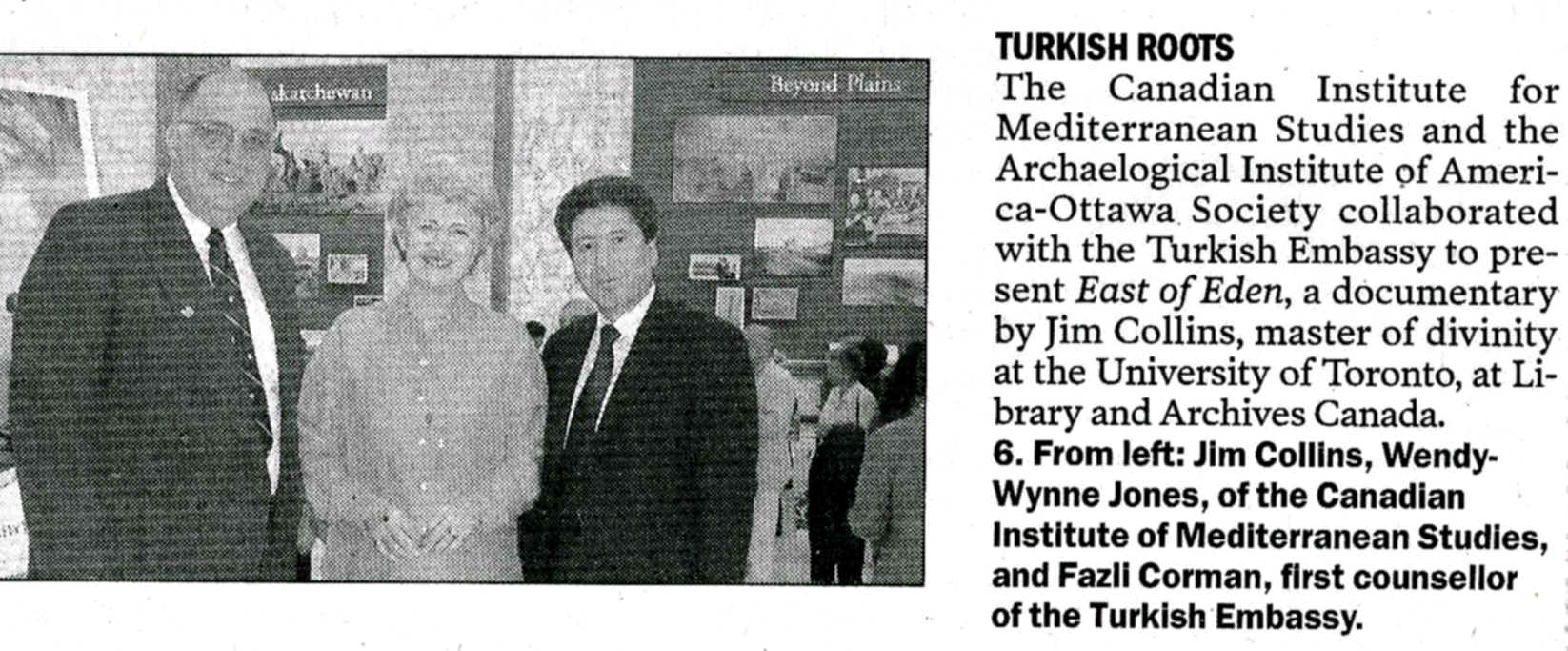
Ottawa Citizen, September 28, 2005
A first one hour episode, The Silk Road, has now been completed to enthusiastic reviews. A further promo for the next hour, Cain and Abel, can be viewed by clicking on the picture below (100 MB Windows Media Player):

In Turkey too is Harran, the biblical place Abraham left to go to Canaan as stated in Genesis. Just north of Harran is Urfa where local tradition holds that Abraham was hidden as a child. An ancient Jewish tradition states that Abraham was brought up in a cave because court astrologers saw a meteor the night of his birth. In the 1950's Oxford University researchers found a tablet with this portent just outside Urfa that a top University of Chicago scholar dated to 1800 BCE.
Key Bene
 fits
fits
nThe Garden of Eden, Mount Ararat and the birth of Abraham are only the beginning of topics to be discussed. Other topics include:
Amen and Divine Wisdom - Justin the Martyr said in his Apology to the emperor c. 150 CE that Amen meant "we all agree" but could it originally have been derived from the Hebrew word 'am' meaning mother - meaning 'feminine wisdom'?
Antioch - Where the Christians Were First Called ChristiansGospel origins - Could Matthew and Luke have been originally addressed to the leaders of Judea c. 40-41 CE paralleling Jeremiah 36?
Saint Paul birthplace in Tarsus, Following the tradition of Cicero the Roman laywer and former governor of Tarsus - a New Perspective on St. Paul's letters and travels
The Origins of the Nicene Creed and other early church councils
nSufi Dancing and the Origins of Turkey as the first Muslim democratic republic.
Science - n. 1. Knowledge (archaic), whence the modern usage 2. Systematic and formulated knowledge (moral, political, natural, etc. such knowledge in reference to these subjects); pursuit of this or principles regulating such pursuit
With the participation of

East to Eden is accepting donations for its work - with Canadian charitable tax receipts issued by Imago.
Cheques or money orders can be made out to "East to Eden", and sent c/o Reverend Jim Collins to
1568 Merivale Road, Suite 387, Ottawa, Ontario K2G 5Y7.
We are especially grateful to Stacy Villeneuve and her grade 11 religion students from St. Pius X High School for their help and participation.
Some interesting links:
The Archbishop of Canterbury
http://www.archbishopofcanterbury.org/1892
The Canadian Conference of Catholic Bishops
http://www.cccb.ca/site/content/view/2617/1149/lang,eng/
The Canadian Institute of Intercultural Dialogue
Charter for Compassion
http://www.charterforcompassion.org
Chautauqua Abrahamic Program
http://www.chautauquaabrahamic.org/
A Common Word
http://www.acommonword.com/index.php?lang=en&page=option1
Mor Eustathius Matta Roham - Archbishop of Jezira and the Euphrates, Syrian Orthodox Church of Antioch
http://www.acommonword.com/index.php?page=responses&item=53
General
Roméo Dallaire Foundation
http://www.romeodallaire.com/foundation.html
Joint Communique of the Archbishop of Canterbury and the Chief Rabbis of Israel
http://www.anglicancommunion.org/acns/news.cfm/2007/10/31/ACNS4332
Just Equipping
Muslim Presence
http://www.muslimpresenceottawa.ca/en/
Ontario Multifaith Council
Peter Ochs - Edgar Bronfman Professor of Modern
Judaic Studies, Co-Founder, Society for Scriptural Reasoning
University of Virginia
http://www.acommonword.com/index.php?page=jewish-responses&item=8
Prison Fellowship International
http://www.pfi.org/about-us/pfi-2011-convocation
Tawfik Hamid - Former Muslim Terrorist
Three Cups of Tea book about building schools to promote peace
http://www.threecupsoftea.com/
World Evangelical Alliance
http://www.acommonword.com/lib/downloads/We_Too_Want_to_Live_in_Love_Peace_Freedom_and_Justice.pdf
January 20, 2013